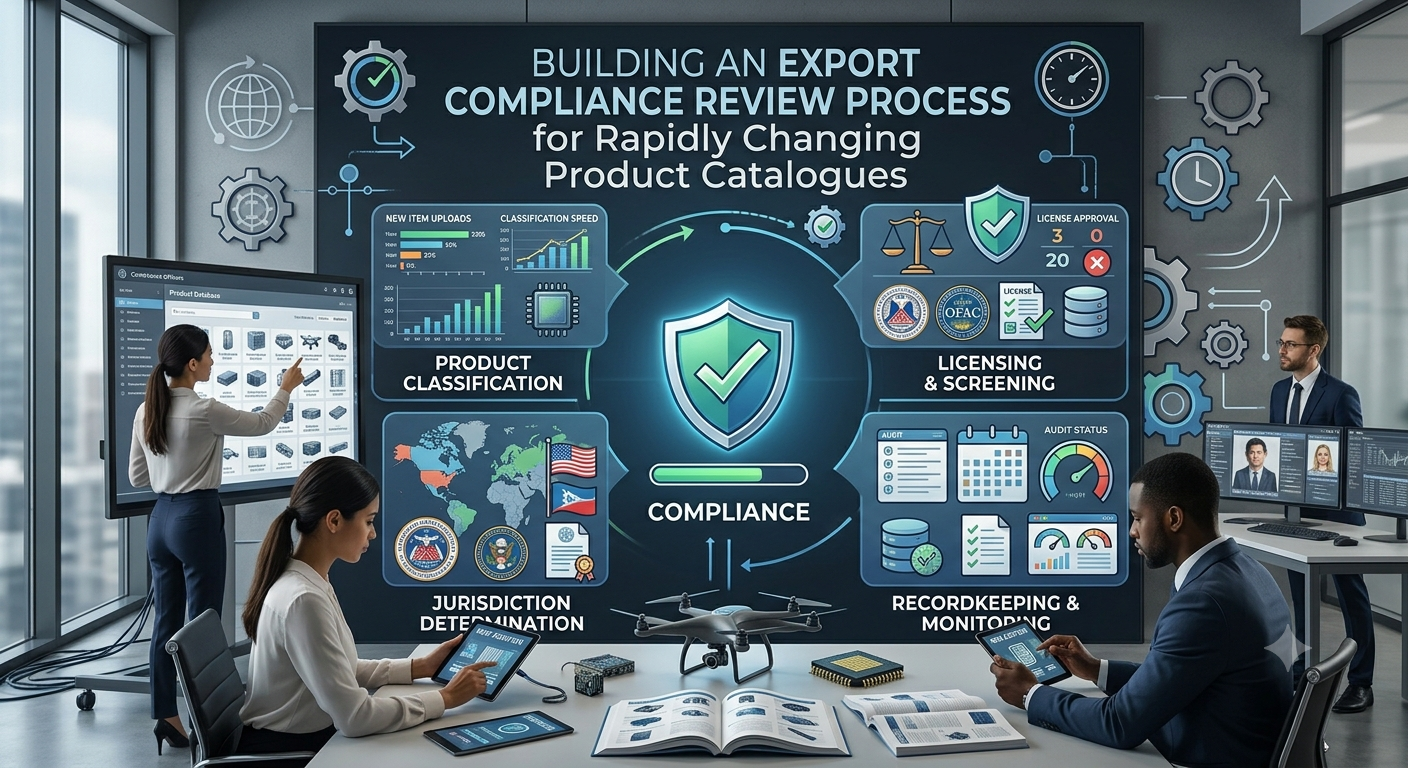
Why Export Compliance Must Adapt to Product Changes
Export compliance becomes significantly more challenging when a product catalogue changes frequently. New products, revised specifications, updated components, and discontinued items can all affect how goods should be classified and exported. A product that previously required one compliance approach may need a different review after a change in materials, technology, destination, or end use. This makes it important for exporters to treat compliance as an ongoing process rather than a one time approval. We understand that fast moving catalogues require a structured system that can keep pace with commercial decisions. A well designed review process helps our teams identify potential compliance concerns before products reach customers or international markets.
Establishing a Product Compliance Ownership Structure
A reliable compliance process begins with clearly defined responsibilities across the organisation. Product managers, sales teams, procurement staff, logistics professionals, and compliance personnel may all hold information that affects an export decision. Without clear ownership, important changes can move through the catalogue without receiving an appropriate compliance review. We recommend establishing a central responsibility for maintaining product compliance records and coordinating reviews when catalogue information changes. This structure should also define who can approve a product for international sale and who must escalate unusual or higher risk situations. Clear accountability reduces the possibility of compliance decisions being overlooked during rapid product development and catalogue updates.
Creating a Product Compliance Information Record
Every exportable product should have a central compliance record containing the information needed for classification and review. This can include product descriptions, technical specifications, materials, country of origin, intended applications, applicable tariff information, export classification information, and relevant documentation. Depending on the product, technical drawings, datasheets, software details, component information, and manufacturing changes may also be important. Keeping these details together allows compliance personnel to evaluate a product without repeatedly requesting information from different departments. The record should also identify the date of the latest review and the person responsible for maintaining it. We find that maintaining consistent product records creates a stronger foundation for export decisions as the catalogue continues to expand.
Introducing a Formal Change Trigger
Not every catalogue update should be treated as a simple administrative change. Changes to product specifications, materials, functionality, software, components, packaging, country of manufacture, or intended use can potentially affect export compliance requirements. A formal change trigger allows the organisation to identify which modifications require a new compliance review before the updated product is released internationally. The trigger should be incorporated into existing product development and catalogue management workflows rather than operating as a separate manual process. This helps ensure that compliance review happens at the right stage instead of after an international order has already been received. A disciplined change trigger can therefore connect commercial product management with responsible export control practices.
Reviewing Export Classification After Product Changes
Export classification should be reviewed whenever a material product change could affect the applicable classification. This is particularly important for products involving specialised technology, advanced components, software, telecommunications functionality, encryption, or other controlled characteristics. Even a relatively small technical modification can sometimes alter the information required to determine the correct classification. Teams should therefore compare the revised product against the information used during its previous classification review. Where necessary, technical specialists should provide sufficient detail for compliance professionals to understand what has changed and why it matters. Maintaining documented classification decisions also provides an important reference when similar products are introduced or modified later.
Connecting Product Reviews With Destination Screening
Product compliance cannot be separated completely from the destination and transaction involved in an export. The same product may require different considerations depending on the destination country, end user, intermediary, intended application, and applicable restrictions. A catalogue review process should therefore establish how product information connects with customer screening and transaction screening procedures. This allows potential restrictions to be identified before sales commitments become difficult to change. Screening should be performed using current and appropriate information because sanctions and trade restrictions can change over time. We treat product review and transaction review as connected stages within a broader export compliance framework.
Monitoring End Use and End User Information
Product descriptions alone may not provide enough information to determine whether an export presents a compliance concern. The intended end use and the identity of the end user can be particularly important for products with specialised or dual use characteristics. Sales teams should therefore capture relevant customer and application information during the order process. Where the proposed use differs significantly from the normal commercial application of a product, the transaction should receive additional scrutiny before shipment. This approach can help identify circumstances where a product that appears ordinary in the catalogue may require closer review because of how it will be used. Maintaining this information also creates a stronger audit trail for future transactions involving the same customer or product.
Managing Supplier and Component Changes
Product catalogues can change because suppliers modify components, manufacturing locations, specifications, or production processes. These changes may appear operational from a purchasing perspective but can have implications for export compliance. A replacement component should therefore be assessed to determine whether its technical characteristics or origin create a new compliance consideration. Procurement teams should communicate relevant supplier changes to product and compliance teams before updated products are released for export. This is particularly important when products contain controlled technologies, specialised components, or software supplied by third parties. Integrating supplier change notifications into the compliance workflow reduces the risk of making export decisions based on outdated product information.
Building a Review Workflow Around Risk
A practical review process should allocate resources according to the level of compliance risk associated with each product. Products with straightforward commercial applications and stable specifications may require a simpler review than products involving advanced technology or sensitive applications. Risk based workflows can help organisations avoid unnecessarily delaying routine catalogue updates while ensuring that higher risk products receive appropriate attention. The criteria used to determine risk should be documented and applied consistently across departments. Review outcomes should also explain why a product was cleared, escalated, or subjected to additional analysis. This creates a more transparent process that can support both operational efficiency and compliance accountability.
Using Version Control for Catalogue Information
Version control becomes increasingly important when products are updated frequently. Compliance teams need to know which technical specifications, classifications, and supporting documents were reviewed at the time an export decision was made. Each significant product revision should therefore have a clear version identifier and effective date. Previous versions should be retained according to the organisation's recordkeeping requirements so that historical decisions can be reconstructed when necessary. This is particularly valuable when a customer, auditor, regulator, or internal reviewer asks why a particular export was approved at a specific time. A controlled versioning system turns product compliance information into a traceable record rather than an informal collection of documents.
Maintaining a Compliance Review Calendar
A catalogue review process should include scheduled checks in addition to change driven reviews. Regulations, sanctions, licensing requirements, classification guidance, and trade restrictions can change even when the physical product remains exactly the same. Periodic reviews help organisations identify products whose compliance information may have become outdated because the external regulatory environment has changed. The frequency of these reviews can be determined according to product characteristics, markets served, regulatory exposure, and organisational risk. High risk product categories may warrant more frequent reassessment than stable, low risk catalogue items. Regular review cycles provide an additional safeguard against relying indefinitely on historical compliance decisions.
Training Teams That Influence Catalogue Changes
Export compliance should not be limited to specialists working within a dedicated compliance department. Product managers, engineers, sales representatives, procurement teams, and logistics personnel can all influence information that affects export decisions. Staff should understand which types of product or customer changes require compliance involvement and where those changes should be reported. Training should use practical examples that reflect the organisation's products, markets, and internal workflows. Refresher training is also useful when regulations, systems, responsibilities, or catalogue structures change. Building compliance awareness across departments makes it easier to identify potential issues before they become shipment or transaction problems.
Integrating Compliance Into Product Lifecycle Management
The strongest export review processes are integrated into the wider product lifecycle rather than added at the final shipping stage. Compliance considerations should be introduced during product development, supplier selection, technical modification, catalogue publication, sales planning, and order fulfilment. This allows potential restrictions to be identified while changes are still relatively easy to manage. It also reduces the likelihood of discovering compliance concerns after a customer has already been promised a delivery date. For organisations with large or frequently changing catalogues, workflow integration can provide greater consistency than relying on individual employees to remember when reviews are necessary. We believe that making compliance part of the product lifecycle creates a more sustainable approach to international trade management.
Documenting Decisions and Escalations
Every significant compliance review should leave a clear record of what was examined and what decision was reached. Documentation may include the product version, technical information reviewed, classification analysis, destination considerations, screening results, supporting evidence, and approval details. When a transaction is escalated, the reason for escalation and the resulting decision should also be recorded. Good documentation allows future reviewers to understand the reasoning without having to reconstruct the entire process from emails and informal conversations. It can also demonstrate that the organisation maintains a structured compliance programme when internal or external reviews take place. Consistent documentation therefore supports both operational continuity and responsible export governance.
Preparing for Rapid Catalogue Expansion
As businesses enter additional markets and introduce more products, manual compliance processes can become increasingly difficult to maintain. Organisations should therefore design their review framework with scalability in mind from the beginning. Standardised product records, defined change triggers, documented approval stages, version control, and centralised compliance information can support larger catalogues without requiring every review to start from scratch. Technology can also help automate workflow notifications, document management, screening processes, and review reminders where appropriate. Automation should support qualified compliance judgement rather than replace the analysis required for complex transactions. A scalable framework allows international growth to continue while maintaining appropriate control over product and transaction information.
Creating a Continuous Compliance Culture
Export compliance is most effective when it becomes part of everyday commercial decision making. A rapidly changing catalogue should not be viewed as a reason to avoid structured reviews, but as a reason to make those reviews more systematic. At American Trade Bridge, we focus on helping businesses approach international trade with processes that recognise the connection between product information, regulatory requirements, customers, destinations, and changing market conditions. A continuous compliance culture encourages teams to raise questions early instead of waiting until an export is ready to leave the warehouse. It also helps organisations respond more confidently when products, suppliers, regulations, or markets change. By building compliance into catalogue management from the beginning, businesses can create a more controlled and sustainable foundation for international growth.
