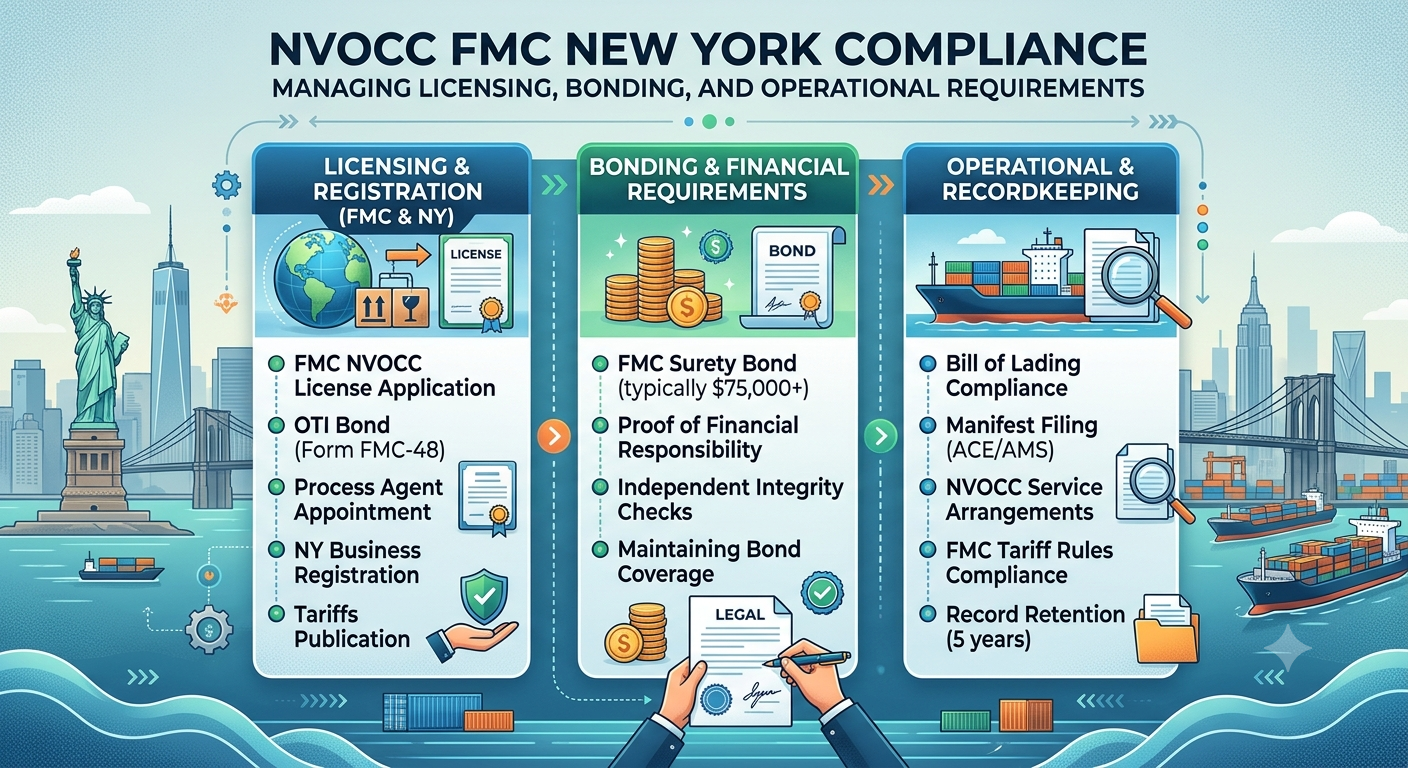
Understanding NVOCC Compliance in New York
Non-Vessel-Operating Common Carriers, commonly known as NVOCCs, play an important role in international ocean freight by arranging transportation without operating the vessels that carry the cargo. In the United States, NVOCC activities involving ocean transportation are subject to requirements established by the Federal Maritime Commission, commonly known as the FMC. For businesses serving customers in New York, understanding these requirements is essential for maintaining compliant and dependable freight operations. Licensing, financial responsibility, tariff obligations, and operational procedures all need to be managed carefully. Compliance is not limited to obtaining an FMC licence because ongoing responsibilities can affect how an NVOCC manages shipments, documentation, pricing, and customer relationships. We help businesses approach these requirements systematically so that regulatory obligations become part of normal freight management rather than an afterthought.
Knowing When an FMC Licence Is Required
The first step in NVOCC compliance is determining whether the business must obtain an FMC licence for its activities. An NVOCC that operates in the United States as an ocean transportation intermediary may need to be licensed by the FMC when it meets the applicable statutory and regulatory requirements. The distinction between a licensed NVOCC and an unlicensed entity that operates under an ocean transportation intermediary framework can have important operational consequences. Businesses also need to understand whether they are acting as an NVOCC, an ocean freight forwarder, or performing functions that fall within both categories. This classification should be established before operational procedures and commercial arrangements are finalised. We focus on helping businesses understand their regulatory position so that their operating model is aligned with the requirements applicable to their services.
FMC Licensing and Registration Requirements
FMC licensing requires an NVOCC to provide information about its business and demonstrate that it meets the Commission's applicable requirements. The application process can involve business details, qualifying individuals, financial responsibility information, and other documentation required by the FMC. A company operating through offices or commercial relationships in New York should ensure that its business information remains accurate and consistent across its regulatory and operational records. Changes involving ownership, business structure, addresses, or other material information may require appropriate regulatory updates. Maintaining accurate registration information is particularly important because compliance responsibilities continue after the initial approval has been obtained. Our approach is to treat licensing as an ongoing compliance responsibility rather than a one-time administrative exercise.
Understanding NVOCC Financial Responsibility
Financial responsibility is a central element of FMC requirements for licensed NVOCCs because it provides protection in circumstances covered by the applicable regulations. An NVOCC must maintain the required form and amount of financial responsibility through an acceptable surety bond, insurance, or other permitted mechanism. The applicable amount can depend on the regulatory status and operating structure of the NVOCC. Businesses should also understand the conditions attached to maintaining that financial responsibility throughout their operations. A lapse, cancellation, or failure to maintain the required financial responsibility can create significant regulatory and operational problems. We encourage businesses to monitor their financial responsibility arrangements continuously and ensure that renewals and related documentation are handled before deadlines become operational risks.
The Importance of the FMC Bond
The FMC bond is an important part of an NVOCC's compliance framework because it supports financial responsibility obligations established under federal regulations. For an NVOCC operating in or serving the New York market, maintaining the required bond helps establish that the company has met an essential regulatory condition for its activities. The bond should be arranged through an appropriate provider and maintained according to the applicable FMC requirements. Businesses should not treat the bond as simply another document stored in a compliance folder because its status can directly affect the company's ability to operate lawfully. Internal teams should know when the bond is due for renewal and who is responsible for monitoring its continuing validity. We incorporate bond management into broader compliance planning so that financial responsibility remains visible throughout the operational year.
Tariffs and Published Shipping Terms
NVOCC compliance also involves obligations relating to tariffs and the terms under which transportation services are offered. Depending on the NVOCC's regulatory status and applicable FMC rules, the company may need to maintain and publish tariff information in the required manner. Tariff requirements can affect rates, charges, rules, and other conditions associated with ocean transportation services. Commercial teams therefore need to ensure that customer quotations and operational documents do not conflict with the company's applicable tariff or regulatory framework. Consistency between published information, quotations, bills of lading, invoices, and shipment records can help reduce compliance exposure. Our processes place emphasis on maintaining clear documentation so that commercial decisions remain consistent with the regulatory obligations governing the NVOCC.
Bills of Lading and Shipment Documentation
Accurate documentation is one of the most important operational aspects of NVOCC compliance. Bills of lading, booking confirmations, invoices, arrival notices, shipping instructions, and related records should accurately reflect the parties, cargo, transportation arrangements, and applicable terms. Errors in documentation can create commercial disputes as well as regulatory concerns, particularly when information differs between internal systems and documents provided to customers or carriers. New York based operations may handle shipments involving multiple international jurisdictions, making consistent documentation even more important. Staff should understand which documents are issued by the NVOCC and which documents originate from ocean carriers or other service providers. We help establish documentation processes that support accuracy, traceability, and consistency throughout the shipment lifecycle.
Managing Carrier and Customer Relationships
An NVOCC operates between multiple parties, including shippers, consignees, ocean carriers, ports, customs professionals, trucking companies, and overseas agents. Each relationship can introduce compliance considerations that need to be reflected in contracts, operating procedures, and shipment documentation. Carrier agreements should clearly establish responsibilities for bookings, rates, cargo handling, documentation, and other relevant transportation services. Customer agreements should similarly explain the NVOCC's role and the terms under which transportation services are provided. Clear allocation of responsibilities can reduce misunderstandings when delays, cargo issues, documentation discrepancies, or unexpected charges occur. We encourage structured relationship management so that regulatory requirements are supported by practical commercial procedures.
Recordkeeping and Compliance Controls
Strong recordkeeping allows an NVOCC to demonstrate how its operations are being managed and provides an important foundation for internal compliance reviews. Shipment records should be organised so that relevant documents can be located and reviewed when required. Businesses should consider maintaining consistent records covering bookings, bills of lading, invoices, communications, rate information, contracts, and other relevant operational materials. Electronic systems can make this process more efficient when documents are properly indexed and access is controlled. Regular internal reviews can also identify missing information, inconsistent records, or procedures that require improvement. Our compliance approach treats recordkeeping as an active operational control rather than simply an administrative requirement.
Managing New York Port Operations
New York and New Jersey form one of the most important maritime gateways for international trade in the United States, creating a complex operating environment for companies involved in ocean transportation. NVOCCs serving this market may coordinate activities involving terminals, drayage providers, warehouses, customs professionals, ocean carriers, and international agents. Port schedules, cargo availability, documentation requirements, and transportation coordination can all influence how efficiently shipments move through the supply chain. Although FMC compliance is federal, local operating conditions can create additional practical considerations for an NVOCC serving New York customers. Effective coordination requires clear communication between regulatory, commercial, and logistics teams. We help businesses build operational processes that recognise both federal compliance responsibilities and the practical realities of managing freight through the New York and New Jersey port environment.
Compliance Training for Operations Teams
Compliance procedures are only effective when employees understand how those procedures apply to their daily responsibilities. Sales teams should understand the boundaries of rate quotations and customer commitments, while operations teams need to understand documentation and shipment handling requirements. Finance teams may be responsible for invoices, charges, and financial records that need to remain consistent with commercial and regulatory documentation. Management should also understand the company's licensing status, financial responsibility arrangements, and major compliance obligations. Regular training can help employees recognise issues before they develop into larger operational problems. We encourage companies to make compliance training part of normal staff development rather than treating it as a one-time exercise during licensing.
Monitoring Regulatory Changes
FMC requirements and related maritime regulations can change over time, making ongoing monitoring important for NVOCCs. Regulatory updates can affect licensing procedures, financial responsibility, tariffs, documentation, reporting, or other areas of ocean transportation activity. A business that relies entirely on procedures developed several years ago may eventually find that its internal practices no longer reflect current requirements. Compliance teams should therefore monitor official regulatory announcements and assess whether changes require updates to policies or operational systems. Management should also establish clear responsibility for reviewing regulatory developments and communicating relevant changes to employees. Our goal is to help businesses maintain compliance systems that can adapt as regulatory expectations and international shipping practices evolve.
Building an Internal Compliance Checklist
A structured internal compliance framework can make it easier for an NVOCC to monitor its responsibilities throughout the year. The framework should cover licensing status, financial responsibility, tariffs, contracts, documentation, recordkeeping, staff procedures, and regulatory updates. Instead of reviewing these areas only when a problem occurs, businesses can establish periodic checks that identify potential gaps before they become serious. Responsibility should be assigned to specific individuals or departments so that important obligations are not overlooked. Management reviews can then provide an additional layer of oversight for areas involving significant regulatory or financial exposure. We use structured compliance thinking to help businesses turn complex requirements into practical processes that can be monitored and improved.
Preparing for Compliance Reviews
An NVOCC should be prepared to demonstrate that its licensing and operational practices comply with applicable requirements if its records or activities are reviewed. Preparation involves more than keeping a copy of the FMC licence because supporting documentation may also be important for demonstrating how the business conducts its activities. Companies should be able to explain their financial responsibility arrangements, documentation procedures, tariff practices, and relevant operational controls. Internal reviews can identify inconsistencies before they become more difficult to correct. Management should also ensure that employees know where important records are maintained and who is responsible for responding to regulatory matters. We recommend maintaining a state of continuous readiness rather than attempting to reconstruct compliance records only when an external review becomes necessary.
Avoiding Common Compliance Problems
Many compliance problems arise from small administrative gaps that develop over time rather than from deliberate disregard for regulatory requirements. Expired financial responsibility, outdated business information, inconsistent documentation, and poorly controlled rate information can create unnecessary exposure. Communication gaps between sales, operations, finance, and management can make these issues more difficult to identify. Companies can reduce these risks by assigning ownership to compliance tasks and establishing regular review procedures. Technology can also help by creating reminders, document controls, approval workflows, and centralised records. We believe that preventing compliance problems through disciplined processes is more effective than relying on corrective action after an operational issue has already occurred.
Creating a Sustainable Compliance Framework
NVOCC compliance should be integrated into the wider business rather than handled as a separate regulatory task. Licensing, bonding, documentation, tariffs, contracts, recordkeeping, and staff training all influence how an NVOCC delivers its services. A sustainable framework connects these areas through clearly documented procedures and defined responsibilities. This approach can also improve operational consistency because employees understand how regulatory requirements relate to everyday shipment management. For companies serving customers in New York, the combination of federal maritime requirements and complex port operations makes structured compliance particularly important. American Trade Bridge supports businesses by helping them approach international trade operations with greater attention to regulatory requirements, documentation, and operational discipline.
Final Considerations for NVOCCs Serving New York
Managing NVOCC compliance requires continuous attention to licensing, financial responsibility, documentation, tariffs, recordkeeping, and operational controls. Businesses serving New York should ensure that their federal FMC obligations are supported by practical processes across sales, operations, finance, and management. Compliance should also be reviewed whenever there are significant changes to ownership, services, business structure, commercial arrangements, or regulatory requirements. A proactive framework can help identify potential gaps before they interfere with customer service or freight operations. It also creates greater visibility into the responsibilities that must be maintained throughout the life of the business. By treating compliance as an integral part of operational management, NVOCCs can build more organised and dependable processes for supporting international ocean freight.
