Licensed NVOCC New York: Architecting Frictionless Global Trade Corridors for Modern Importers
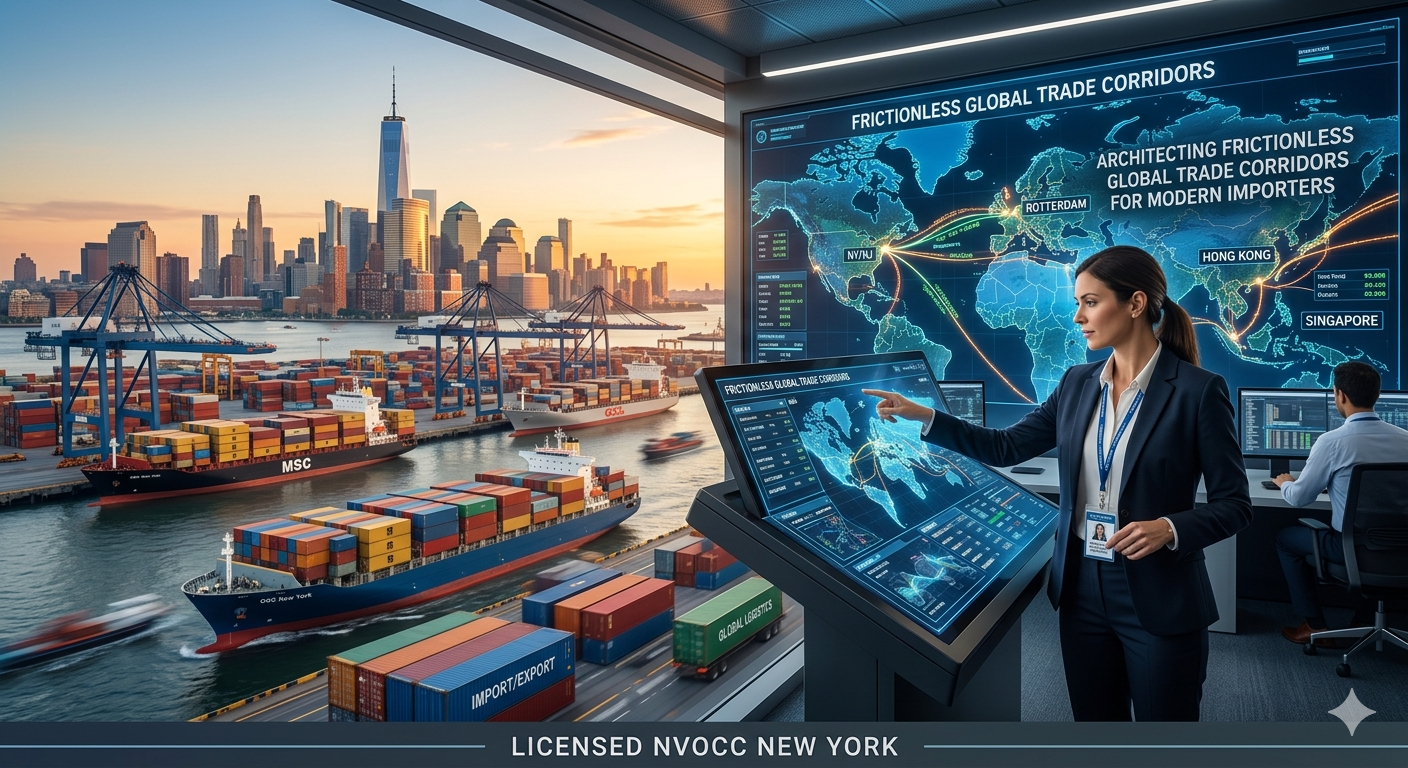
Licensed NVOCC New York
Global trade no longer rewards companies that simply move cargo from port to port. It rewards those who can design resilient, responsive, and compliant logistics ecosystems. As a licensed NVOCC in New York, we at American Trade Bridge operate beyond traditional freight forwarding. We engineer structured trade corridors that reduce volatility, increase visibility, and give our clients measurable operational control.
Redefining the Role of a Licensed NVOCC
A licensed Non Vessel Operating Common Carrier is often misunderstood as a middle layer in shipping. In reality, it functions as a strategic logistics architect. We issue our own bills of lading, consolidate cargo, negotiate carrier space, and assume responsibility for cargo movement across international routes.
In New York, one of the most complex and high throughput trade environments in the world, licensing is not just regulatory compliance. It is a signal of operational maturity. It reflects our ability to manage documentation precision, financial liability, and international trade laws with consistency.
Our role is not passive coordination. We actively shape how goods move, when they move, and under what conditions they move.
The New York Advantage in Global Trade Design
Operating as a licensed NVOCC in New York gives us access to a uniquely dynamic logistics ecosystem. The region integrates major seaports, air cargo hubs, rail intermodal systems, and extensive warehousing networks. This allows us to build multi modal solutions that are not only efficient but adaptive.
We leverage this ecosystem to create what we call responsive shipping lanes. These are routes that can shift based on congestion, geopolitical shifts, seasonal demand, or carrier capacity constraints. Instead of reacting to disruptions, we anticipate and reroute before they impact delivery timelines.
Corridor Engineering Instead of Shipment Handling
Most logistics providers focus on individual shipments. We focus on trade corridors.
A trade corridor is a structured pathway that includes origin consolidation, carrier allocation, customs clearance strategy, inland distribution, and final delivery optimization. By designing corridors instead of processing shipments, we create consistency across large volumes of cargo.
For example, an importer bringing goods from Southeast Asia into the United States does not just need a shipping provider. They need a repeatable system that ensures every shipment follows a predictable and optimized path. We design that system, test it, and continuously refine it.
Licensing as a Risk Control Mechanism
In global trade, risk is often hidden in documentation errors, compliance gaps, and misaligned liability structures. As a licensed NVOCC, we operate with a regulatory framework that enforces accountability at every step.
We maintain strict adherence to filing requirements, tariff regulations, and cargo reporting protocols. This reduces the probability of customs delays, penalties, or shipment holds. More importantly, it provides our clients with a stable compliance foundation that supports long term scaling.
Licensing also allows us to take ownership of cargo contracts, giving clients a single accountable partner instead of fragmented responsibility across multiple vendors.
Intelligent Consolidation Strategies
One of the most underutilized advantages of working with a licensed NVOCC is cargo consolidation. In New York, where import volumes are high and diverse, consolidation becomes a powerful optimization tool.
We group compatible shipments to maximize container utilization while maintaining cargo integrity. This reduces cost per unit, improves transit efficiency, and minimizes environmental impact.
But our consolidation is not static. We use demand patterns, seasonal forecasting, and client shipping behavior to dynamically adjust consolidation strategies. This ensures that efficiency does not come at the cost of speed.
Visibility as a Core Infrastructure Layer
Visibility in logistics is often treated as an added feature. We treat it as infrastructure.
Our systems are designed to provide real time tracking, predictive arrival estimates, and exception alerts across every stage of the shipping process. This allows our clients to align inventory planning, sales operations, and distribution strategies with actual cargo movement.
In a market like New York, where port congestion and inland delays can shift timelines rapidly, this level of visibility transforms uncertainty into actionable intelligence.
Integrating Compliance with Velocity
A common misconception in global shipping is that compliance slows down operations. In reality, when structured correctly, compliance accelerates movement.
We integrate customs documentation, regulatory checks, and trade compliance into the early stages of the shipping process. This proactive approach reduces clearance times and prevents last minute disruptions.
By aligning compliance with operational flow, we eliminate the friction that typically exists between speed and accuracy.
Custom Trade Frameworks for Scaling Businesses
Every importer has a different growth trajectory. Some scale through volume, others through diversification of sourcing regions, and others through market expansion.
As a licensed NVOCC in New York, we build custom trade frameworks that align with these growth patterns. This includes selecting optimal carrier networks, designing warehouse distribution models, and structuring documentation workflows that can scale without breaking.
Our objective is to ensure that as our clients grow, their logistics systems become more efficient rather than more complex.
The Future of NVOCC Operations in New York
The next phase of global trade will be defined by adaptability. Static supply chains will struggle to compete in an environment shaped by rapid demand shifts, regulatory changes, and evolving consumer expectations.
We see the role of a licensed NVOCC evolving into a hybrid of logistics provider, data strategist, and risk manager. In New York, this evolution is already underway.
At American Trade Bridge, we are investing in smarter routing algorithms, deeper carrier integrations, and enhanced data analytics to stay ahead of this shift. Our focus is on building systems that not only move cargo but continuously optimize how that cargo moves.
Building Long Term Trade Stability
Ultimately, the value of working with a licensed NVOCC is not measured in a single shipment. It is measured in long term stability.
We provide our clients with a structured, compliant, and adaptive logistics environment that supports consistent growth. By transforming fragmented shipping processes into engineered trade corridors, we create reliability in an otherwise unpredictable global landscape.
In New York, where the pace of trade is relentless and the margin for error is minimal, this approach is not optional. It is essential.
At American Trade Bridge, we do not just move goods. We design the pathways that keep global commerce flowing with precision and control.
