Customs Binding Ruling as a Strategic Advantage in Cross Border Trade
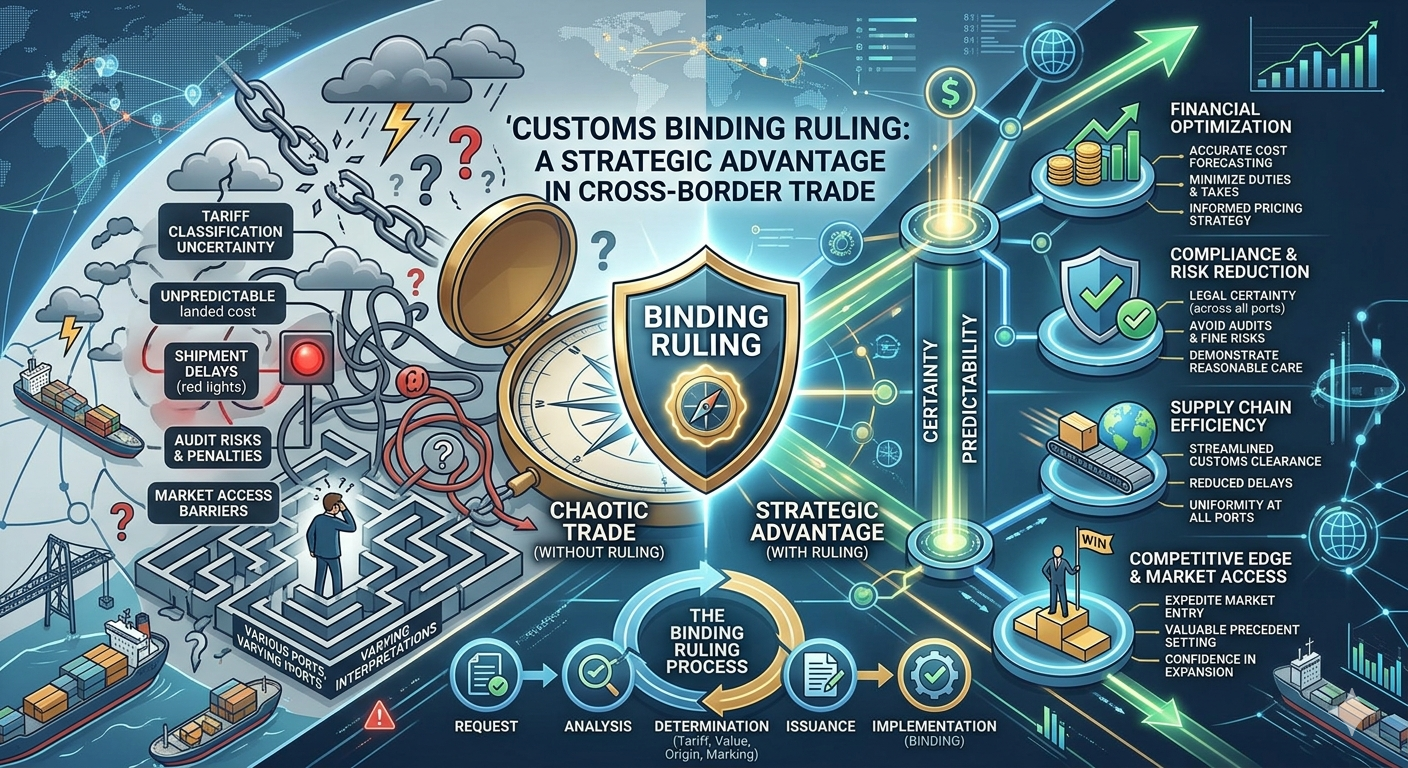
Customs Binding Ruling as a Strategic Advantage in Cross Border Trade
International trade is no longer just about moving goods from one country to another. It is about precision, compliance, and predictability. For importers and exporters operating in complex regulatory environments, uncertainty in classification, valuation, or origin can lead to delays, penalties, and financial exposure. This is where customs binding rulings become a powerful strategic tool rather than just a regulatory formality.
At American Trade Bridge, we approach customs binding rulings not as paperwork, but as a proactive framework that strengthens trade operations and reduces long term risk.
What Is a Customs Binding Ruling
A customs binding ruling is an official decision issued by a customs authority that provides a definitive interpretation of how specific goods will be treated under customs law. This typically includes:
• Tariff classification
• Country of origin determination
• Valuation methodology
• Applicability of trade agreements
Once issued, the ruling is legally binding on customs authorities for the goods described, provided all facts remain consistent.
This transforms uncertainty into clarity.
Why Businesses Underestimate Its Strategic Value
Many companies only consider binding rulings when disputes arise or when customs challenges a shipment. This reactive approach misses the real advantage.
A well timed ruling can:
• Prevent misclassification penalties
• Ensure consistent duty calculations
• Support accurate pricing strategies
• Reduce clearance delays
• Strengthen audit readiness
Instead of firefighting compliance issues, businesses can operate with a defined regulatory position from the outset.
Turning Compliance into Predictability
In global trade, predictability is a competitive advantage. Without a binding ruling, companies often rely on internal interpretations or third party advice that may not align with customs authorities.
This creates variability in:
• Duty exposure
• Documentation requirements
• Clearance timelines
By securing a binding ruling, we establish a fixed interpretation that customs must follow. This reduces ambiguity across every shipment tied to that ruling.
The Role of Technical Accuracy
A successful customs binding ruling depends heavily on how the application is prepared. It is not just about submitting a request. It involves:
• Detailed product descriptions
• Technical specifications
• Manufacturing processes
• Intended use cases
• Supporting documentation
Even minor inconsistencies can lead to unfavorable rulings or delays.
At American Trade Bridge, we ensure that every submission is technically sound and aligned with how customs authorities evaluate goods. This precision significantly increases the likelihood of a favorable and durable ruling.
Industry Specific Complexity
Certain industries benefit more from binding rulings due to classification complexity:
Advanced Manufacturing
Products with multiple components or hybrid functions often fall into gray areas of tariff schedules.Technology and Electronics
Rapid innovation leads to products that do not fit traditional classifications, increasing the risk of inconsistent treatment.Textiles and Apparel
Origin rules and material composition can drastically affect duty rates and compliance requirements.Chemicals and Pharmaceuticals
Regulatory oversight and classification nuances require absolute clarity to avoid enforcement actions.
In these sectors, a binding ruling is not optional. It is essential.
Reducing Financial Risk

Incorrect classification or valuation can result in:
• Retroactive duty assessments
• Monetary penalties
• Shipment seizures
• Increased audit scrutiny
A binding ruling acts as a safeguard. It demonstrates due diligence and provides legal backing for how goods are declared.
This is particularly important for companies scaling their import volumes. Small errors multiplied across shipments can lead to significant financial exposure.
Supporting Trade Agreement Optimization
Trade agreements offer reduced or zero duty rates, but only when strict criteria are met. Determining eligibility often involves complex origin rules.
A binding ruling can confirm:
• Whether a product qualifies under a specific agreement
• How origin rules apply to multi country supply chains
This allows businesses to confidently claim benefits without fear of future disputes.
Long Term Operational Efficiency
Beyond compliance, binding rulings streamline internal processes:
• Standardized documentation across shipments
• Faster customs clearance
• Reduced reliance on case by case interpretation
• Improved coordination between logistics and compliance teams
This consistency becomes especially valuable as companies expand into new markets.
When to Apply for a Binding Ruling
Timing is critical. The best moment to pursue a ruling is before large scale import activity begins.
Ideal scenarios include:
• Launching a new product line
• Entering a new international market
• Changing suppliers or manufacturing processes
• Experiencing repeated classification inconsistencies
Early action prevents costly corrections later.
Our Approach to Binding Rulings
At American Trade Bridge, we take a structured and strategic approach:
1. Product Analysis
We conduct a deep technical review of the product and its characteristics.
2. Regulatory Mapping
We align the product with applicable tariff schedules and legal notes.
3. Documentation Preparation
We compile precise and comprehensive supporting materials.
4. Submission and Follow Up
We manage communication with customs authorities to ensure clarity and completeness.
5. Implementation Guidance
Once the ruling is issued, we help integrate it into operational workflows.
This end to end process ensures that the ruling is not just obtained, but effectively utilized.
The Future of Trade Compliance
As global trade regulations become more sophisticated, reliance on assumptions will become increasingly risky. Authorities are leveraging data, automation, and stricter enforcement mechanisms.
In this environment, binding rulings will play an even greater role in:
• Ensuring regulatory alignment
• Supporting digital customs systems
• Reducing friction in cross border movement
Businesses that adopt a proactive compliance strategy will outperform those that remain reactive.
Final Perspective
Customs binding rulings are often viewed as a technical requirement. In reality, they are a strategic asset that brings clarity, consistency, and control to international trade operations.
At American Trade Bridge, we believe that compliance should not slow businesses down. It should enable them to move with confidence.
By leveraging binding rulings effectively, companies can transform uncertainty into a structured advantage in the global marketplace.
