FMCSA Freight Broker License as a Strategic Asset in Cross Border Logistics
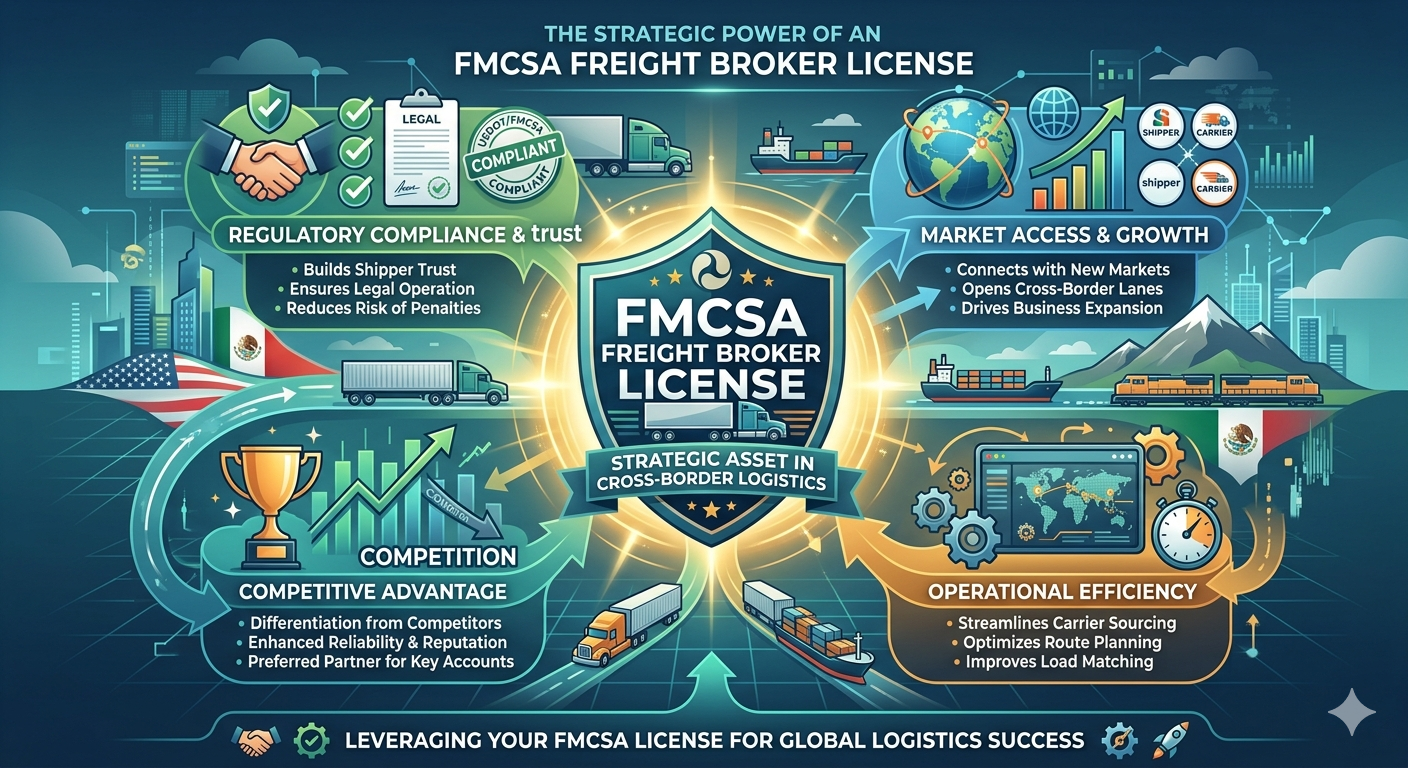
FMCSA Freight Broker License as a Strategic Asset in Cross Border Logistics
In the modern freight economy, regulatory compliance is no longer a background function. It is a competitive instrument. Securing an FMCSA freight broker license is not simply about legal authorization. It is about positioning a brokerage operation for scalable growth, financial credibility, and operational resilience in an increasingly regulated transportation market.
At American Trade Bridge, we view the FMCSA freight broker license as a structural foundation for long term logistics strategy rather than a basic administrative requirement.
Understanding the Regulatory Architecture
The Federal Motor Carrier Safety Administration regulates interstate freight brokerage in the United States. Any entity that arranges transportation for compensation between shippers and authorized motor carriers must hold broker authority under federal law.
To obtain this authority, applicants must:
• Register through the Unified Registration System
• Obtain a USDOT number
• Secure a surety bond or trust fund in the amount of 75,000 dollars
• Designate process agents across all states
• Maintain ongoing compliance with federal regulations
This structure is designed to ensure financial responsibility and accountability within the transportation ecosystem. However, for forward looking logistics companies, it also creates a measurable barrier to entry that strengthens market credibility.
The Financial Signaling Effect of the 75,000 Dollar Bond
One under discussed dimension of the FMCSA freight broker license is the financial signaling power of the BMC 84 bond or BMC 85 trust fund. The 75,000 dollar requirement functions as a risk mitigation mechanism for carriers and shippers. More importantly, it acts as a screening tool that filters undercapitalized operators from the marketplace.
When structured properly, the bond does more than satisfy regulatory compliance. It becomes a reputational asset. Carriers are more willing to extend capacity and flexible payment terms to brokers who demonstrate financial discipline. Shippers perceive lower counterparty risk when engaging a bonded brokerage.
For cross border logistics operations, especially those coordinating freight between the United States and Mexico or Canada, this financial credibility plays a decisive role in contract negotiations.
Compliance as an Operational Framework
Holding broker authority through the Federal Motor Carrier Safety Administration establishes more than permission to operate. It imposes ongoing compliance obligations such as:
• Maintaining accurate transaction records
• Preserving carrier qualification documentation
• Ensuring transparent rate confirmations
• Responding to regulatory audits
These obligations create a documented operational framework. When properly implemented, they reduce disputes, improve claim defensibility, and strengthen internal process controls.
At American Trade Bridge, we integrate compliance documentation into our logistics workflow rather than treating it as a separate administrative function. This alignment enhances both regulatory standing and operational efficiency.
Broker Authority and Cross Border Specialization
Many logistics providers underestimate the complexity of cross border brokerage. While the FMCSA freight broker license authorizes interstate brokerage within the United States, cross border freight introduces additional regulatory layers, customs coordination, and multi jurisdictional risk management.
Broker authority becomes a foundational credential when negotiating with:
• Customs brokers
• Drayage carriers
• Transload facilities
• Cross docking warehouses
Without proper federal authorization, these partnerships cannot be structured with contractual certainty. A licensed brokerage demonstrates to partners that it operates within a recognized regulatory perimeter.
Risk Allocation and Contract Strategy
Another less discussed benefit of holding a properly structured FMCSA freight broker license lies in contractual risk allocation. Brokers function as intermediaries. Their liability exposure depends heavily on documentation, carrier vetting procedures, and regulatory compliance.
With licensed authority, brokers can:
• Draft enforceable brokerage agreements
• Establish indemnification provisions with legal clarity
• Maintain documented proof of compliance
• Demonstrate due diligence in carrier selection
This is particularly critical in high value freight categories such as electronics, automotive components, or time sensitive agricultural goods.
By integrating compliance controls into brokerage operations, American Trade Bridge strengthens contractual defensibility while facilitating efficient freight movement.
Building Scalable Brokerage Infrastructure

For companies entering the brokerage space, the FMCSA freight broker license is not the endpoint. It is the infrastructure layer upon which scalable systems are built.
After licensing, growth depends on:
• Carrier network development
• Credit management systems
• Technology integration for load tracking
• Structured onboarding protocols for shippers
Licensing provides regulatory legitimacy. Structured systems convert that legitimacy into revenue stability.
Organizations that treat broker authority as a strategic asset rather than a compliance checkbox tend to outperform competitors who approach it reactively.
The FMCSA freight broker license represents more than regulatory approval. It is a financial, operational, and strategic instrument that shapes credibility in the freight marketplace.
For logistics providers seeking to build durable brokerage operations, particularly in complex cross border environments, federal broker authority functions as both a compliance mandate and a competitive differentiator.
At American Trade Bridge, we align regulatory compliance with long term logistics strategy, ensuring that broker authority strengthens trust, scalability, and cross border execution capacity.
