Export Compliance in New York: Managing Deemed Exports and Intangible Technology Transfers
Export Compliance in New York: Managing Deemed Exports and Intangible Technology Transfers
Export compliance in New York is often discussed in the context of shipping goods overseas. However, one of the most complex and frequently misunderstood risk areas involves deemed exports and intangible technology transfers. In a state driven by finance, biotech, software development, and advanced research, compliance is no longer confined to ports and warehouses. It extends into laboratories, cloud servers, and boardrooms.
At American Trade Bridge, we work with organizations that operate in high innovation environments where sensitive technical data moves faster than physical products. We help our clients design compliance frameworks that reflect this reality.
Understanding Deemed Exports in New York
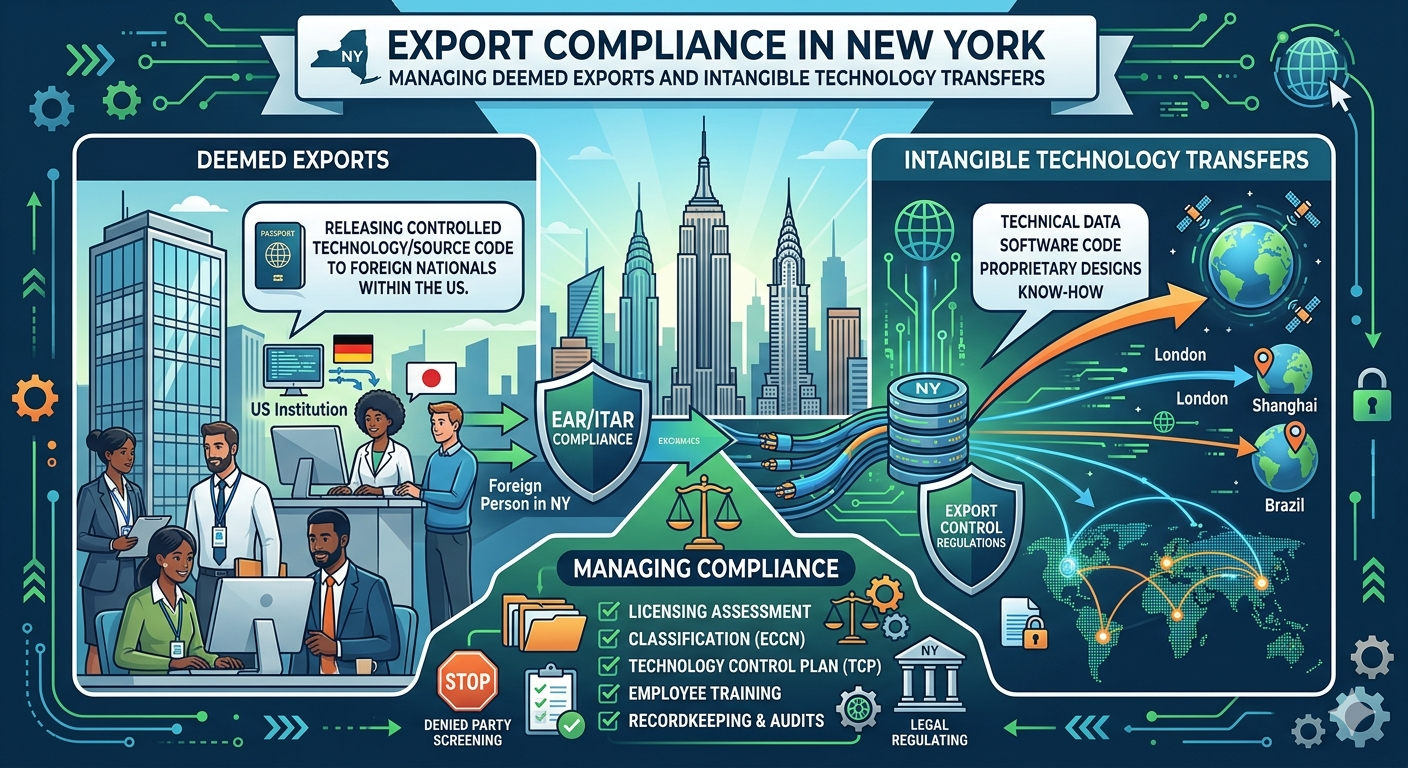
A deemed export occurs when controlled technology is released to a foreign national within the United States. In a city like New York, where global talent is essential to growth, this issue arises more often than many companies realize. Sharing technical drawings, granting access to encrypted repositories, or discussing controlled specifications in a meeting can all trigger regulatory obligations.
Federal oversight primarily falls under the Export Administration Regulations administered by the Bureau of Industry and Security, as well as the International Traffic in Arms Regulations overseen by the Directorate of Defense Trade Controls. These regulations do not distinguish between physical and digital disclosures. If controlled information is accessed by a foreign national employee, contractor, or researcher, it may be treated as an export.
For New York based fintech firms, biotech startups, and AI developers, this risk is particularly acute. Intellectual property is often the core asset, and internal collaboration platforms frequently host sensitive datasets or source code.
Intangible Transfers Through Cloud Infrastructure
New York companies rely heavily on distributed cloud systems. While cloud storage increases operational efficiency, it also creates compliance exposure. If servers are located outside the United States, or if foreign persons can remotely access export controlled information, regulatory triggers may apply.
Compliance requires more than a written policy. It demands technical controls such as role based access permissions, encryption protocols, audit trails, and documented screening procedures. A compliance program must integrate IT governance with export classification analysis.
We often advise clients to conduct a technology mapping exercise. This identifies which data sets are subject to control, where they reside, who can access them, and under what authority. The result is a defensible compliance architecture rather than a reactive response after an audit or enforcement action.
Research Institutions and Dual Use Technology

New York is home to major universities and research institutions engaged in advanced engineering, quantum computing, pharmaceuticals, and aerospace collaboration. Many projects involve dual use technology, meaning it has both civilian and military applications.
Even when research qualifies for fundamental research exclusions, ancillary activities may not. Sponsored research agreements, proprietary development contracts, or restricted data sharing can alter the compliance landscape. Institutions must evaluate grant language, publication restrictions, and access controls with precision.
Export compliance in this context is a governance issue, not just a legal one. It requires coordination between research administrators, compliance officers, IT departments, and executive leadership.
Enforcement Trends and Risk Mitigation
Regulatory agencies have increased scrutiny of intangible exports and internal data governance. Penalties for non compliance can include civil fines, criminal liability, denial of export privileges, and reputational damage that affects investor confidence.
A proactive compliance program typically includes:
• Formal export classification procedures
• Screening of foreign nationals and counterparties
• Controlled technology access protocols
• Internal training tailored to technical teams
• Periodic compliance audits
At American Trade Bridge, we structure compliance programs that align operational workflows with regulatory expectations. Our approach focuses on building internal capacity so organizations can manage export risk confidently and sustainably.
Export compliance in New York is no longer limited to containers crossing borders. It is embedded in daily business operations, especially where technology and international collaboration intersect. Companies that understand this shift position themselves for secure and compliant global growth.
