How New York’s Port Geography Influences the Strategic Value of a Customs Bonded Facility
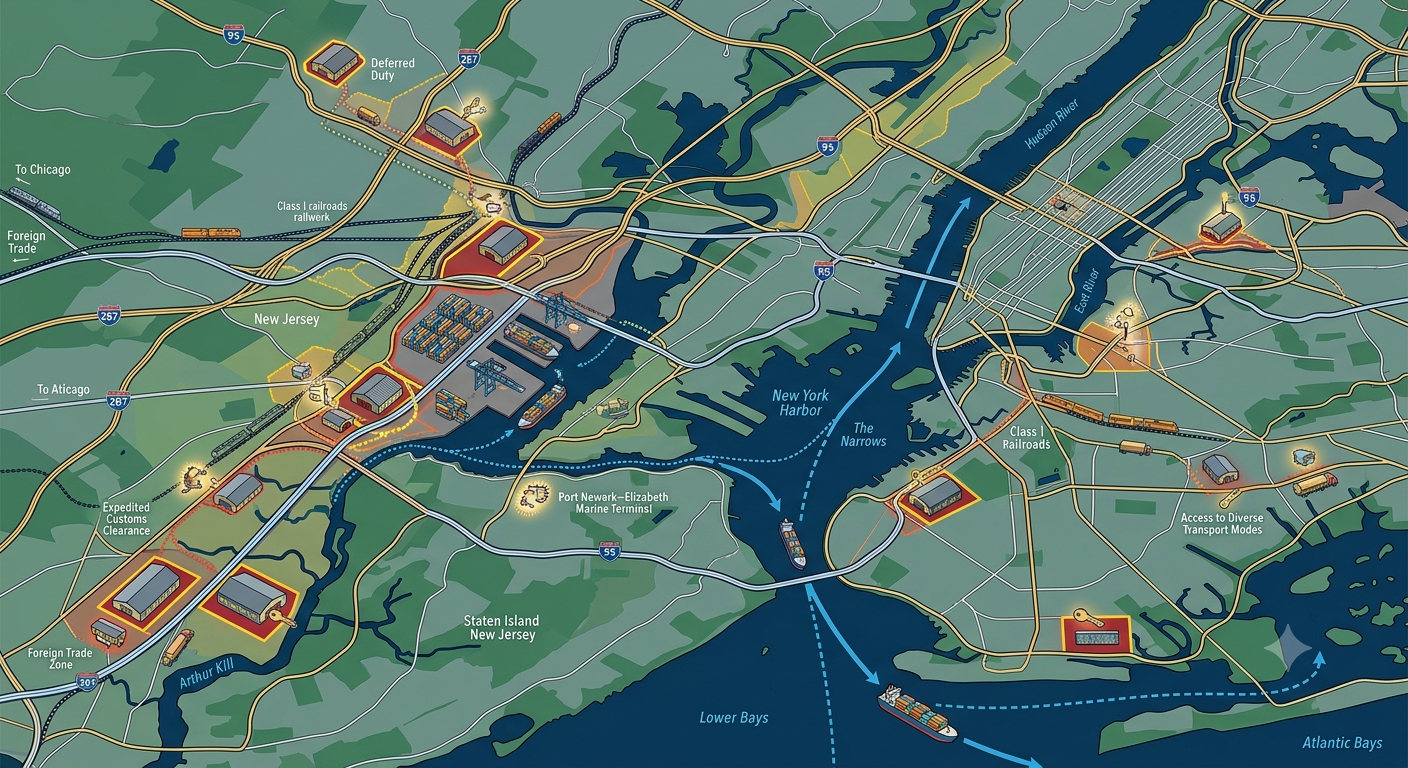
Understanding New York’s Unique Port Geography
New York’s position on the Atlantic coast has made the region one of the most strategically important gateways for international trade in the United States. The Port of New York and New Jersey connects ocean shipping routes with a vast network of highways, rail lines, distribution centers, airports, and commercial markets throughout the Northeast and beyond. This geographic advantage means that imported cargo can move from international vessels into domestic supply chains with access to one of the largest concentrations of consumers and businesses in the country. However, geography alone does not determine how efficiently an importer can manage international cargo after it reaches the port. The location of warehouses, customs facilities, transportation corridors, and distribution infrastructure can significantly influence landed costs and operational flexibility. A customs bonded facility positioned within this broader logistics environment can provide importers with additional control over when and how duties are addressed. We evaluate these geographic relationships carefully when helping businesses consider customs bonded solutions for their international supply chains.
The Port of New York and New Jersey as a Regional Gateway
The Port of New York and New Jersey serves a market that extends well beyond the immediate waterfront. Its influence reaches across New York, New Jersey, Connecticut, Pennsylvania, New England, and other major commercial regions through established transportation networks. The port's proximity to major population centers gives importers an important advantage because products can move toward substantial consumer and commercial markets without first traveling across the country. At the same time, the enormous volume of cargo entering the region creates a need for sophisticated inventory management, customs coordination, warehousing, and transportation planning. Importers must therefore consider more than the distance between a vessel and a warehouse when designing their logistics strategy. The relationship between port access, bonded storage, customs procedures, and final distribution can determine whether an import operation remains flexible or becomes unnecessarily expensive.
Why Location Matters for Bonded Cargo
A customs bonded facility is particularly valuable when its location supports the movement of international cargo without forcing importers into unnecessary logistical steps. Imported merchandise held under bond can remain within the customs framework while the importer determines the appropriate next stage for the goods. This can be particularly relevant for businesses dealing with products that may not immediately enter the U.S. domestic market. Instead of treating every container arrival as an immediate duty and distribution event, an importer may be able to use bonded storage as part of a broader inventory strategy. The geographic relationship between the port and the bonded facility becomes important because every additional movement can introduce transportation costs, handling requirements, scheduling considerations, and potential delays. Our approach is to consider the complete cargo journey rather than evaluating a bonded facility solely according to its warehouse footprint or advertised services.
The Importance of Proximity to Marine Terminals
The physical distance between marine terminals and a bonded facility can have a meaningful effect on transportation planning. Shorter drayage distances can simplify container movement and potentially reduce the exposure to some transportation-related costs. However, proximity should not be interpreted simply as being located a few miles from a terminal. A strategically useful facility must also be accessible through practical transportation routes and compatible with the operational requirements of the cargo. Traffic patterns, bridge crossings, appointment systems, terminal procedures, and trucking availability can all influence the real-world value of a particular location. A facility that appears geographically close on a map may not necessarily provide the fastest or most predictable cargo movement. For this reason, we examine transportation connectivity alongside physical distance when assessing the strategic value of a customs bonded operation.
New York’s Highway Connections Expand the Bonded Facility Advantage
One of the major strengths of the New York and New Jersey port region is its connection to an extensive highway network. Major interstate routes provide access to surrounding states and important inland distribution markets, allowing imported products to move efficiently from port areas toward warehouses, manufacturers, retailers, and customers. A customs bonded facility with strong highway connectivity can therefore function as more than a storage location. It can become a strategic transition point between international arrival and domestic distribution. This becomes especially valuable for companies managing cargo that may ultimately be distributed across several states or regions. By considering highway access as part of the bonded warehouse decision, importers can better understand how a facility fits into their complete supply chain rather than viewing it as an isolated customs location.
Rail Access and Inland Distribution Potential
Rail infrastructure adds another layer to New York’s geographic advantage. While trucking remains critical for short-distance movements and final delivery, rail can provide an important option for certain long-distance cargo flows. Businesses moving substantial quantities of imported merchandise may benefit from facilities and transportation plans that connect maritime arrivals with inland rail networks. A bonded facility located within a broader multimodal logistics environment can give importers greater flexibility when transportation requirements change. Rail access may also become more relevant when businesses need to move goods beyond the immediate Northeast market. The strategic value of a bonded location therefore depends partly on how effectively it can interact with multiple transportation modes. We consider these connections because supply chains increasingly require alternatives rather than dependence on a single transportation channel.
Access to Major Consumer Markets
New York’s port geography provides unusually close access to one of the largest concentrations of consumers and businesses in North America. This creates an important advantage for importers whose customers are located throughout the Northeast. Merchandise can enter through the port region and remain strategically positioned for distribution without immediately being transported to a distant inland warehouse. A bonded facility can add another layer of flexibility by allowing eligible imported merchandise to remain under customs control while commercial decisions are made. This can be useful for companies managing uncertain demand, seasonal products, international inventory, or goods intended for destinations outside the domestic market. The combination of market proximity and customs flexibility can make a well-positioned bonded facility an important component of a larger import strategy.
Customs Bonded Storage and Cash Flow Considerations
The strategic value of bonded storage is not limited to geography because customs procedures can also influence financial planning. Depending on the applicable customs requirements and the nature of the merchandise, goods placed in a bonded environment may receive treatment that allows duties and certain import-related obligations to be managed according to the applicable bonded warehouse framework rather than being handled immediately upon arrival. This can provide importers with additional time to determine how merchandise will be distributed, exported, or otherwise handled. For companies with significant import volumes, the timing of customs-related payments can become an important part of working capital management. However, the financial benefits depend on the specific transaction structure, merchandise, customs status, and applicable regulations. We therefore view bonded warehousing as a strategic customs and logistics tool rather than assuming that every importer will receive the same financial outcome.
Managing Cargo Destined for Reexport
New York’s position as an international gateway is especially relevant to companies that import merchandise with the possibility of reexporting it. A business may receive goods through the port but later determine that some or all of the merchandise should be sent to another international market. In such circumstances, customs bonded storage can potentially provide an appropriate environment for maintaining control of the goods while their final destination is determined. This can reduce the need to treat every shipment as though it is immediately entering the domestic market. The geographic advantage becomes even stronger when the facility can support efficient movement between the port, warehouse, and outbound transportation networks. Businesses engaged in international distribution should therefore consider bonded warehousing as part of their reexport strategy rather than viewing it only as a temporary storage solution.
The Role of Container Freight Stations
Container freight stations can play an important role in the movement and handling of international cargo within the New York logistics ecosystem. Depending on the nature of the shipment, cargo may require consolidation, deconsolidation, examination, handling, documentation coordination, or other specialized processes. The location of a CFS relative to marine terminals and inland transportation routes can affect how efficiently these activities are performed. When bonded capabilities are incorporated into the overall operation, importers may gain additional flexibility in managing merchandise before it proceeds into the domestic supply chain. This can be particularly useful for companies handling consolidated shipments or cargo arriving from multiple international suppliers. The most effective facility is therefore one that aligns customs requirements, cargo handling capabilities, transportation access, and the importer’s broader operational model.
Port Congestion Makes Strategic Planning More Important
Port geography also has to be evaluated in the context of congestion and variability. High cargo volumes, terminal conditions, truck availability, weather, labor considerations, and changing transportation schedules can affect the timing of container movements. A customs bonded facility cannot eliminate these external variables, but its strategic placement can provide additional options for managing cargo once transportation arrangements are possible. Businesses that rely on a single tightly timed movement from vessel to domestic distribution can have less flexibility when delays occur. A properly integrated bonded warehouse strategy can create an additional layer of operational control. This is why location should be assessed in terms of resilience and contingency planning rather than simply average transit times.
How Facility Location Influences Drayage Economics
Drayage represents one of the most important transportation considerations when evaluating a port-adjacent warehouse. Even relatively short container movements can involve costs associated with trucking, fuel, appointments, chassis availability, waiting time, tolls, and other operational factors. A facility located in a strategically connected area may help simplify these movements, although the actual economics depend on prevailing transportation conditions and shipment characteristics. Importers should also consider whether cargo will require multiple moves before reaching its final destination. Unnecessary handling can increase both cost and operational exposure. Our focus is therefore on understanding how the bonded facility fits into the entire movement pattern from terminal arrival through storage and eventual disposition.
Warehousing Flexibility for Changing Import Volumes
International trade rarely follows a perfectly predictable pattern. Import volumes can change because of seasonal demand, supplier changes, consumer behavior, promotional campaigns, manufacturing schedules, or shifts in international sourcing. A strategically positioned bonded facility can give businesses more flexibility when inventory timing changes. Instead of designing a logistics network around a fixed assumption about when every shipment will enter domestic commerce, importers can use appropriate storage arrangements to create additional decision-making time. This can be particularly valuable for businesses that import large quantities but sell products gradually. Geographic positioning strengthens this flexibility because inventory can remain close to major transportation corridors and commercial markets while the company determines its next move.
Supporting Supply Chain Diversification
Modern importers increasingly seek to diversify suppliers, transportation modes, and distribution locations. New York’s port geography can support this objective because the region connects international maritime traffic with extensive domestic logistics infrastructure. A customs bonded facility can serve as one component of a diversified network rather than being treated as the sole destination for imported cargo. Businesses may use different facilities for different product categories, markets, or customs requirements depending on their operational structure. Such flexibility can reduce dependence on a single warehouse or transportation route. A carefully selected bonded location can therefore contribute to supply chain resilience while supporting the broader geographic strategy of the importer.
Choosing a Facility Based on the Entire Supply Chain
The best customs bonded facility is not necessarily the one closest to a port terminal. A stronger evaluation considers the relationship between the facility, ports, highways, rail networks, airports, customers, suppliers, and final distribution points. Importers should also evaluate warehouse capabilities, customs procedures, security controls, cargo handling processes, documentation practices, and operational responsiveness. The facility must support the actual nature of the merchandise and the customs strategy rather than simply offering bonded status as a standalone feature. A warehouse that performs well operationally but creates inefficient transportation patterns may not deliver the expected strategic value. Conversely, a strategically located facility with strong customs and logistics capabilities can become an important part of an importer’s competitive infrastructure.
The Strategic Perspective for Importers
New York’s port geography creates opportunities that extend far beyond the initial arrival of a container. The combination of maritime access, major population centers, highway infrastructure, rail connections, distribution networks, and international trade activity creates a highly interconnected logistics environment. Customs bonded facilities can add strategic value within this environment by providing eligible importers with additional flexibility over the timing and movement of merchandise. The benefits become stronger when the facility is selected according to the complete supply chain rather than a single geographic measurement. Businesses should therefore assess how customs, warehousing, transportation, inventory, and market access interact before choosing a facility. American Trade Bridge helps businesses evaluate these relationships so that customs bonded warehousing can function as part of a coordinated international trade strategy rather than simply as a place to hold imported goods.
Building a More Efficient New York Import Strategy
A successful import strategy requires alignment between geography and customs planning. New York’s port region offers access to international shipping routes and a dense domestic transportation network, but businesses still need to select facilities and transportation arrangements that match their specific cargo flows. The strategic value of bonded storage depends on how effectively it supports those flows, including domestic distribution, reexport activity, inventory timing, and customs management. Companies that understand these relationships can make better decisions about warehouse placement and transportation planning. They can also identify opportunities to reduce unnecessary cargo movements and improve operational flexibility. Our role is to help businesses understand the customs and logistics considerations surrounding their international cargo so they can build a more deliberate and efficient supply chain.
Looking Beyond the Warehouse Door
The value of a customs bonded facility should ultimately be measured by what it enables throughout the supply chain. A strategically positioned facility can connect port operations with inventory management, customs compliance, transportation planning, and final market access. New York’s geography makes this particularly important because the region contains an unusually dense combination of international gateways and domestic distribution infrastructure. Businesses that take advantage of these geographic relationships can potentially improve flexibility while creating a more structured approach to managing imported merchandise. The right facility can become an operational asset that supports both immediate cargo requirements and longer-term international trade objectives. By looking beyond the warehouse door and considering the entire movement of goods, importers can make more informed decisions about how customs bonded storage fits into their overall strategy.
